
Share Ernest Ramirez Palomino's obituary with others.
Invite friends and family to read the obituary and add memories.
Stay updated
We'll notify you when service details or new memories are added.
You're now following this obituary
We'll email you when there are updates.
Select your format and elements to print

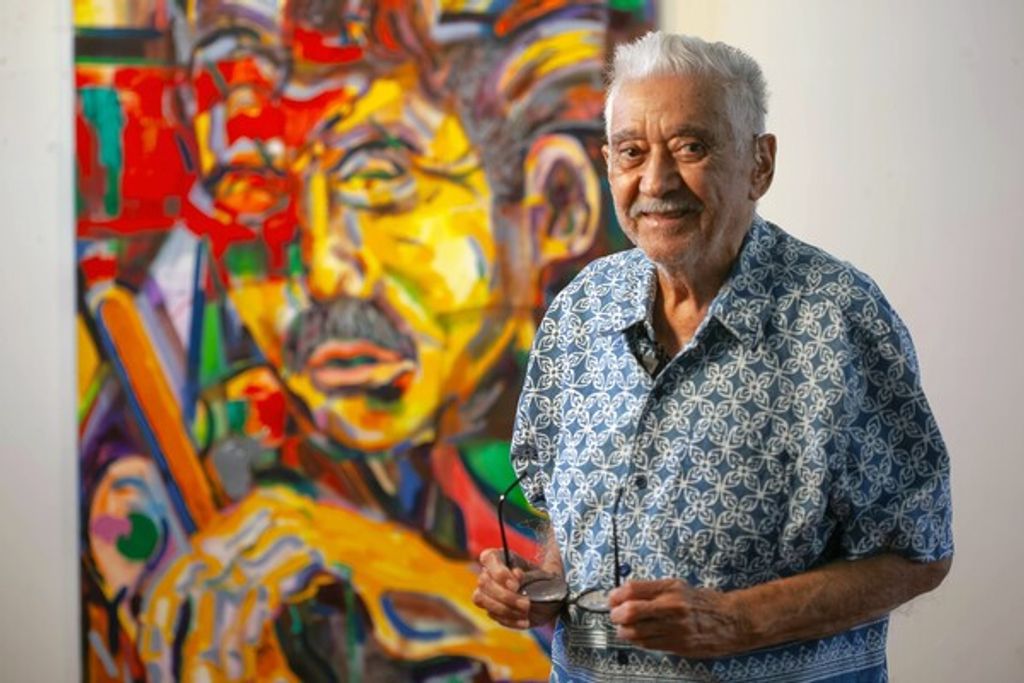
IN LOVING MEMORY OF Ernest Ramirez Palomino
Ernest Ramirez
Palomino
Dec 21, 1933 — Oct 24, 2023
Fresno
Ernest Ramirez Palomino's Obituary
Dr. Ernesto Palomino, Professor Emeritus of Chicano Art
Prominent Chicano artist, educator and activist Ernesto "Ernie" Palomino died on October 24, 2023 at the age of 89. Palomino was a prominent participant in the Chicano cultural movement of the 1970s and 1980s, and his works gained national recognition from the National Endowment for the Arts and Humanities. As part of his cultural activism, in 1975 he was one of the founding leaders of La Brocha del Valle, a legendary collective of artists from Fresno and the central valley of California who left a legacy of public murals with images of social struggles in the region. of farm workers and the Chicano experience.
Ernesto Palomino was born and raised in a family of farm workers in Fresno, California. He attended Edison High School, and then went on to earn a Master of Fine Art degree from San Francisco State University. Late in life he received an honorary Doctorate from California State University, Fresno.
Beginning in 1970, Dr. Ernesto Palomino taught at California State University, Fresno; first in the Department of La Raza Studies, and then in the Department of Arts. Palomino's art foundation, La Brocha del Valle or The Brush of the Valley was created to elevate Chicano culture by Chicano artists. Regarding this, Palomino said, in a Santa Barbara University archived video interview on October 8, 1983 by producer Philp Brookman, "I got young people together and created La Brocha de Valle, which became established. Then of course [La Brocha] became sponsored by a Universidad Campesinos Libres." Palomino goes on to say, "La Brocha was able to bring half a million dollars to this area just in terms of monies for employment; monies to promote culture and art. We were kind of at the forefront of a lot of these things that are taken for granted by federal art agencies, like California Arts Council. In fact we contributed to the California Arts Council for it to become a viable source for bilingual cultural events. Also the National Endowment for the Arts and Humanities, we contributed to that also. In 1978 we became non-existent. We lost our non-profit status. Now I'm at a point where I've gotten classes [at Fresno State University] organized again, Chicano art classes. And they will be offered as an on-going thing, permanently. In fact the chairman of the art department has stated that he wants a Chicano in there until the end of the world."
In 1970 Palomino, along with Lee Orona created the first Chicano murals in Fresno, beginning with the Farmworkers Mural. In 1972 he created the Raza Mural for the Madera community. These murals feature Chicano themes such as the UFW strike eagle, the skull, an image of Quetzalcoatl, and a portrait of Juárez, Mexico's first liberal president. In 1997 Palomino told us, [Radio Bilingüe] in an interview: "The first time I saw a mural by Diego Rivera and (José Clemente) Orozco was late, when I was 22 years old, in Guadalajara, in Orozco's studio. So I had a lot of respect for him… The murals were a group issue, a community issue, establishing institutions of art."
Palomino began his career in the arts in the 1950s. In 1956 he published his book, "In Black and White: Evolution of an Artist." Palomino called his work from that time "gabacho art" (or Anglo art), in reference to the junk materials incorporated into his sculptures from this period; pieces that were included in his autobiographical animated film, "My Trip in a '52 Ford." From 1968 to 1969 Palomino worked in Denver for the Migrant Council, where he filmed the lives of migrant workers as part of an effort to bring more federal support. Ernesto Palomino also participated in the organization of the La Raza Unida Party.
In the 1997 interview on Radio Bilingüe Palomino said: "My first ideas were the theme of family. "I have always been interested in the topic of family life." Regarding his vision of his art practice, Palomino said in an interview on Radio Bilingüe: "The world of art is therapy because it is necessary for people to live… Art is a way of organizing and caring for our Mexican, Mexican-American and Mexican values. Chicanos." Furthermore, at all times he had a motivation for cultural and political activism in his career as an artist: "We could get rich selling our art work; but we made the decision to be Chicano artists; and that is beyond being a person who wants to make art to sell."
Together with his then wife, Joyce Marie Palomino, he raised five children: Jocelyn Palomino, Fresno Palomino, Joaquín Palomino, Calvin Palomino and Billy Palomino and leaves behind grandchildren Sol Segura and Esteban Segura.
Ernie Palomino will always be present. Long live the Maestro!
Written by Hugo Morales for Radio Bilingüe October 27, 2023
Translated from Spanish by Google Translate
Edited by Jocelyn Palomino, Executive Director of La Brocha Art Foundation
Funeral Services for Ernest Ramirez Palomino

Reception
Friday
Fresno State-Conley Art Gallery
1:00 - 3:00 pm
Ernest Ramirez Palomino's Guestbook
Visits: 11
This site is protected by reCAPTCHA and the
Google Privacy Policy and Terms of Service apply.
Service map data © OpenStreetMap contributors